Inky Learns Not to Get Fooled
“1,000 free gems — just type in your password.” “It’s me from a new account, send me the code from the text.” A Buy button on a parent’s card. Five short stories about Inky the kitten: how these tricks work and what to do — and a poster for the wall with the three rules he now knows.
Free · no sign-up · the child never types a name or an email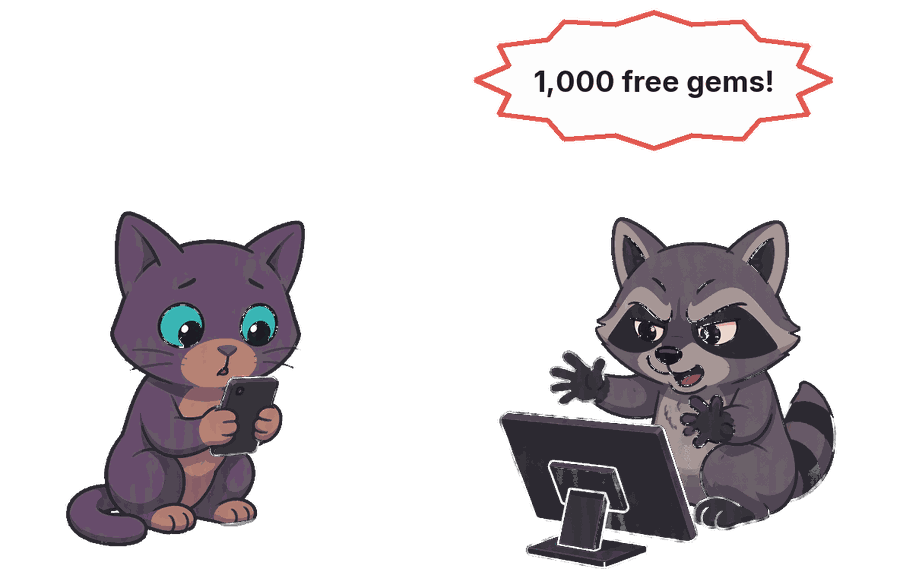
Read
A picture, the characters’ lines and a short explanation underneath. For kids who comfortably read a few lines on a screen.
StartComic
The same story told entirely in pictures: lines and thoughts in bubbles, the rule of each lesson as one icon. Not a word of text next to the pictures.
StartFor parents: if your child has already tapped
A child stays quiet not because they don’t understand what happened. They stay quiet because they’re afraid of your reaction — and the more expensive the mistake, the bigger the fear. Everything that decides the outcome fits into your first sentence.
- First: “good thing you told me right away.” If the first thing is “how could you”, next time they won’t tell you — and you won’t get these minutes.
- Call the bank if a card or a payment is involved. Through the app or the number on the card — not a link from a message. Almost anything can be stopped right away and almost nothing the next day.
- Change the account password and the password of the email it’s tied to. While a stranger has access, nothing else matters.
- Don’t delete anything. The chat, the “friend’s” username, the link — they show what happened and let you warn the real friend.
What the course is about
Kids in games and chats aren’t hacked — they’re asked. Politely, urgently, and in a way that looks like ordinary game talk: “I’ll give you a skin”, “only three spots left”, “it’s me, send the code”. The course doesn’t scare and doesn’t ban games. It shows the three tricks almost every scam like this is built on, and one thing to do against each.
They promise something free — and ask for a password
Real gifts in a game are given inside the game. If you have to go somewhere else and type something in to get the gift — it’s not a gift. Nobody who gives gifts needs your password.
They rush you
A timer, “only 3 spots left”, messages one after another. When you’re rushed, you don’t have time to think — that’s exactly why they rush you. “Almost gone” is easy to check: look again tomorrow.
They write as a friend
The same profile picture, a username one letter off, and “send me the code from the text, it came to you by mistake”. A code from a text is a key: right now someone is trying to get into the child’s account, and this code is the only thing they’re missing. There is one check — ask the friend where you usually talk, not by replying to that message.
- Passwords and text codes: never share.
- Being rushed? Time to stop and think.
- Tapped the wrong thing? Tell a grown-up right away.
The last lesson is about what to do after a mistake
Sometimes you tap anyway. It happens to everyone — grown-ups too. The bad part isn’t the tap; the bad part is staying quiet afterwards. A grown-up isn’t there to get you in trouble but to act before it’s too late: call the bank, stop a payment, change a password. This lesson ends with a short note for the grown-up reading it together with the child.
What your child will be able to do afterwards
- Tell a gift inside the game from “go to this link and type in”
- Notice they’re being rushed, and understand why
- Check “almost gone” the simplest way — look again tomorrow
- Never share or forward a code from a text — with anyone, ever
- Check a “friend from a new account” where you usually talk
- Stop in front of a Buy button and ask, because the money isn’t theirs
- Recognize a “free trial” as a purchase, just a delayed one
- Tell a grown-up right away instead of waiting for it to “work itself out”
What’s in the course
There’s no such thing as free skins
Where a stranger gets gems you don’t have, and why real gifts are given inside the game.
“Everyone’s got theirs, you’re the last one”
The timer and “only 3 spots left” as a trick. Who hurrying helps and how to check it.
A friend from a new account
The same profile picture, a username one letter off, and a request for the code from a text.
One button — someone else’s money
A one-tap purchase on a parent’s card. Why asking is normal, not “little”.
Tell a grown-up right away
What to do if you tapped anyway, and why the harm comes from the silence, not the mistake.
Each lesson ends with a short four-question quiz. Questions are drawn from a larger pool, so a retake gives a different set. They test whether the child can apply the rule in a new situation, not whether they remember the picture.
Frequently asked questions
- What data does the child enter?
- None. No name, no email, no age — not at the start and not at the end. The course opens from a link and is completed as is. Progress is kept in the browser on that device.
- What does the child get at the end?
- Not a certificate — a poster: the three rules of the course, Inky the kitten, and a space where the child writes their own name. The poster comes as one PDF in six designs, from a plain one for a home printer to a coloring page, so you can choose together which one goes on the wall.
- How do the two versions differ?
- The story is the same: the same five lessons, the same characters, the same quizzes and the same poster. Only the telling differs. In the first, every picture has the characters’ lines and a short explanation under it. In the second there is no text next to the pictures at all — everything is said with bubbles and icons. We noticed that some kids simply scroll past text under a picture; the second version is for them.
- What age is it for?
- It’s written for ages 9–12: the child already plays and chats on their own. For younger kids — with a parent alongside, and the comic version is the better pick. Older kids won’t be hurt by it either: the tricks are the same as in adult scams, only the bait is skins instead of a “prize”.
- Is it really free?
- Yes, and there is no paid part. Cletica makes money from organizations that train their staff — not from kids or parents.
- Should we do it together?
- The course is built so a child can take it alone. But the last lesson — that telling a grown-up right away is safer than staying quiet — works best when the grown-up is right there and says it themselves: “if anything happens, tell me, you won’t be in trouble.” There is a separate note for that.
For a school or a club
The course can be given to a whole class with one link — no sign-up and no data collected about the kids. If you need to see who completed it, the same course can be assigned as a list with per-student progress on Cletica. There is also an adult course on scams for parents and employees.